By Elliot, Semester 62
The first week of our Bridged Curriculum is all about origin stories. Students read origin stories from many cultures and discuss their meaning and impact. They then are given an assignment in Environmental Science Class to write their own “Science Origin Story,” which you can read below.
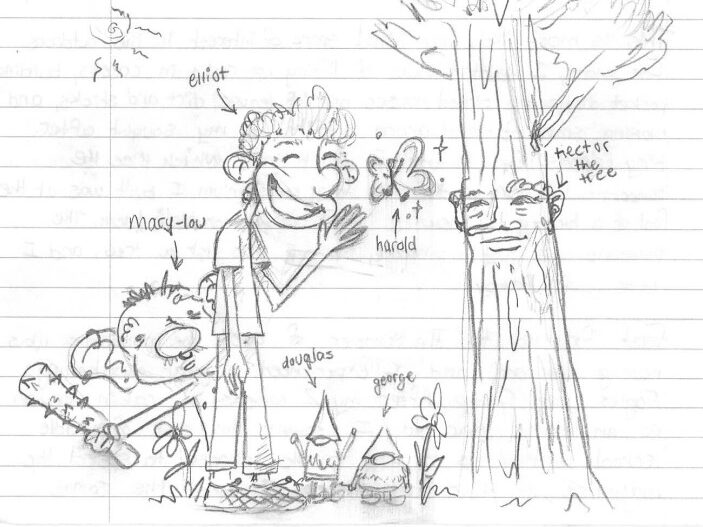
Other kids in my elementary school classes had passions and interests in subjects such as dinosaurs, ballet, yellow crayons, or trains. None of these were found to be a practical hyper-fixation in my six-year-old mind. Instead, I spent the majority of my independent studies on fairies, trolls, and ESPECIALLY gnomes. I quickly came to learn that it is quite rare to find my preferred topics in the non-fiction section of the library. I couldn’t wrap my head around the fact that the rest of the world didn’t feel the need to know things like the anatomy or diet of abnormally small people with red hats. This frustrated me (and still does) but didn’t stop me. I grasped matters into my own hands and briskly took to the field.
This is, most likely, my initial spark of interest in the outdoors. For years I devoted hours, lifting up rocks in creeks, building pocket-dictionary-sized houses out of leaves, dirt, and sticks, and making small felt and acorn outfits for my sought after tiny friends. Even though I didn’t know which tree the pinecone fell from, or that the fairy condominium I built was at the foot of a hickory, I knew I liked being around them. The pinecone was just a pinecone, the tree was just a tree, and I was just happy.
Fast-forward to the summer of 2021, the pandemic was nearing the end and I experienced a great awakening: Eagle’s Nest Camp. After my two weeks in Cabin 7 as an 11-year-old, I spent the rest of middle school baffled as to why people choose to spend the majority of their lives inside. It was the same frustration I felt in the “G” section of a nonfiction wing in the library. For three weeks a year, I’d find myself more engaged and excited to learn than I did the entire school year, trapped behind a desk and under fluorescent lights.
Although I have yet to see a red-capped bearded 2-inch man, for the next semester, I will be able to pursue knowledge of the environment through experiential education. To my 15-year-old mind, this is much more practical than yellow crayons, ballet, and dinosaurs, and I’d now reluctantly argue that environmental studies is almost even with gnome, fairy, and troll studies.