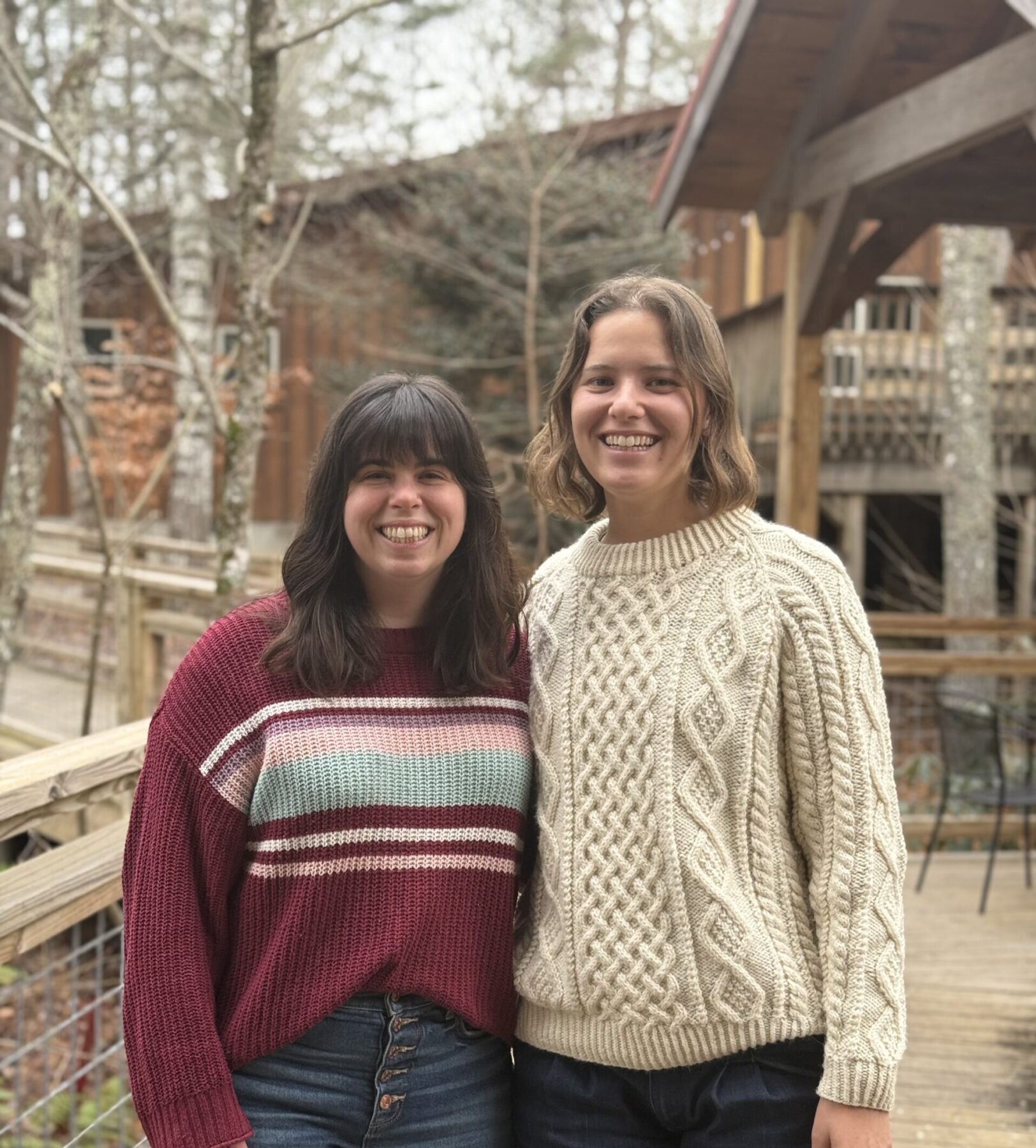
Want to get to know the OA admissions process and our admissions team? Read on for perspectives from Katie Rowlett, Admissions Director and OA Semester 28 alum, and Mia Prausnitz-Weinbaum, Admissions Counselor and OA Semester 46 alum.
What’s a creative project submission you’ve seen as part of an OA application that stands out to you?
Katie: “Oh gosh, the range of creative projects I’ve seen over the years is incredible. Of course we’ve gotten some amazingly creative videos and art projects, but once someone baked a cake as an answer for her project, that was awesome. We’ve gotten a fully hand-drawn and bound book that just clearly took so much time and that was very impressive.”
Mia: “One project that really stood out to me was a quilt that someone submitted. It highlighted the student’s favorite activities and it was cool to see how they kind of lined up with the OA Four Cornerstones: Environment, Community, Craft, Intellect.
Katie: “And those are all projects that are cool because they related to the person who made them. It doesn’t mean you have to have an art skill that stands out as different. We just want to know something more about you. And those were creative ways of answering those questions for those students.”
What does the application include? How long does it take?
Mia: “The first step to apply to OA is to fill out our Application Registration form on our website, which lets us know that you want to apply. Then you submit the rest of your application materials. So, these materials include some basic information about you and your school, five short answers, which should be thought out and well-written, but should not be essays, one creative response which is really up to you for the format, but it should reflect your personality and what you want us to know about you.
“Then, we also need your grades from the last two years of school as well as recommendations from two of your teachers, or one can be a mentor of another sort. And finally, we have some short questions for parents or guardians to answer about you too. It can take a week or two to gather all the materials including the things we need from your school, but for the responses it will depend so much on the person how long it takes, especially what you decide to do for your creative response. I would say to set aside a couple hours to really work on the written responses, plus time to brainstorm and create your creative response.”
Katie: “I always like to say, remember, this is not an application to college. We ask for short answers. We ask for, yes, a creative project. It takes a lot of intention, but we don’t mean it to be this super long and stressful process.”
What are you looking for in an OA applicant?
Katie: “What we want from a student is just that clear intention that they’re saying, okay, I might be scared. I might not know quite every single thing about OA, but I am ready to try something new or try something different or challenge myself or have fun with school for the first time or to get out into the wilderness and show some of the skills that I already know or to come to a new state for the first time… I just want a student to share why they are genuinely interested in this experience and that goes further than anything else, whether it’s that “perfect” creative piece or the perfect 4.0 GPA.”
When do I apply to OA?
Mia: “You can apply to OA during your ninth, tenth, or eleventh grade years. OA is open to tenth and eleventh graders, so you can start applying the year before, or you can apply during rolling admissions the same year that you want to come. For example, right now, it’s Fall, and we have tenth and eleventh graders applying for this upcoming Spring semester, and ninth and tenth graders applying for next school year.”
You’re both OA alumni. What was your favorite part of OA as a student? And what is your favorite part as faculty?
Katie: “It’s always so hard to choose one thing, but I think the aspect of OA that was most unexpectedly impactful as a teenager was the community here. And it was how meaningful those peer relationships were, as well as the relationships I had with my teachers and faculty and how much they cared about us, which I got some at [my sending] school, and it was just on a next level at OA. So that’s stuck with me to this day, those friends and those mentors.
“And as a faculty member, that is still really important as well, the community, but I think meeting all the different types of students who want to come to OA is just the best part of my job because it can be the right fit for so many different teenagers and it’s just so fun to meet them.”
Mia: “Yeah, it’s so hard to choose. But as a student, probably the class experience was the most impactful for me. I really felt like I went back to my school at home feeling so much more excited about learning and it was like night and day in my excitement for learning and going to school every day.
“And now as a faculty member, probably craft and community, but I’ll say craft because Katie already said community. There’s just so much knowledge and so many resources here to make really cool crafts. And craft is so ingrained into the community part as well, which I love.”
Thanks for reading! Feel free to reach out to admissions@enf.org with your questions that we didn’t answer here!